Here you will find information about our service portfolio.
Please contact us if you have any questions or would like an initial quote.
Imaging procedures
System setup for inline analysis (HSI, IMS)
System design based on hyperspectral imaging
Hyperspectral imaging (HSI) is an imaging process for continuous data acquisition and evaluation in real time. HSI thus creates an excellent basis for inline inspections of production flows.
An important field of application for hyperspectral imaging is, for example, quality control in food production.
System setup using ion mobility spectrometry
Rapid analysis of volatile substances: Ion mobility spectrometry (IMS) analyzes volatile compounds for their chemical composition.
IMS-based analysis is characterized by low detection limits (lower ppb range) and short measurement times (approx. 20 sec).
Evaluation of optical data sets (chemometrics)
Evaluation and processing of optical data sets (chemometrics)
Modern sensors and measuring systems such as spectrometers or camera systems provide large amounts of highly complex data. We use special chemometric methods to extract the information relevant to you from large data sets.
We support you in analyzing your data to answer specific questions and in the model-based calculation of your target parameters. In the form of feasibility studies, we develop customized hardware and software components to answer analytical questions from a wide range of applications in industry, life sciences and diagnostics.
Our services
- Spectral and hyperspectral measurement of samples in the wavelength range from 400 – 2,500 nm
- Laboratory chemical analysis of samples in our accredited food laboratory
- Analysis of measurement data with regard to correlation to target parameters
- Selection of information-carrying wavelength ranges
- Selection and optimization of pre-processing methods
- Training and validation of regression and classification models
- Creation of customized software components for processing and evaluating sensor data
- Selection and configuration of customized spectral and hyperspectral measurement systems
Contact
Florian Meuche
Department Manager Equipment Development

phone +49 3603 – 833 194
Sensor validation / optics design
Optical measuring instruments
The composition and surface properties of materials can be characterized by interactions between light and matter. Modern optical analyzers use physical effects such as absorption, reflection, transmission or the scattering of light to measure certain properties of a sample.
Efficient development saves costs
For the development of efficient and cost-optimized optical analysis instruments, precise knowledge of the optical properties of the samples to be analyzed is essential. Based on this knowledge, optimally tailored technical solutions can be designed. This can reduce both development time and costs (for hardware, among other things).
State-of-the-art test laboratory and expertise
With our extensively equipped spectroscopy laboratory, our expertise in the field of optical metrology, modern simulation tools and innovative AI-based evaluation methods, we support you in the development of optimized optical measurement and analysis devices.
Our services
- Measurement of absorption, reflection, transmission and scattering in the wavelength range of 200 – 4000 nm (UV – MIR) for the identification of problem-relevant wavelengths
- Simulation of the position and performance of light sources for the selection of suitable components
- Simulations for the optimization of beam paths
- Simulation of required detector areas for photodiodes
- Consulting on the design of electronic circuits for signal acquisition and processing
Contact
Florian Meuche
Department Manager Equipment Development
phone +49 3603 – 833 194
Microbiological processes
Microbiological laboratory tests
fzmb test laboratory for food, water and environmental samples
The fzmb test laboratory carries out a variety of microbiological laboratory tests. This involves determining and evaluating the contamination of samples (products, rooms, equipment) by microorganisms.
The methods used include microbial cultivation on culture media, microscopic and biochemical identification, resistance tests and molecular methods.
Our team of 15 employees analyzes around 45,000 samples per year for product composition and/or microbiological safety, among other things. The test laboratory is accredited in accordance with DIN EN ISO 17025.

Information as PDF

Contact and opening hours
fzmb GmbH
Food testing department
Geranienweg 7
99947 Bad Langensalza
Tel.: 03603 / 833 172
Fax: 03603 / 833 174
E-Mail:
Our opening hours are
Mon – Fri from 07.00h to 16.00h.
Access road
Please walk/drive through the blue gate at the entrance of the institute into the inner courtyard.
You will find us about 50m diagonally to the right in building C.
Parking is available in front of the entrance.
Inactivation of microorganisms
Inactivation of bacteria and viruses
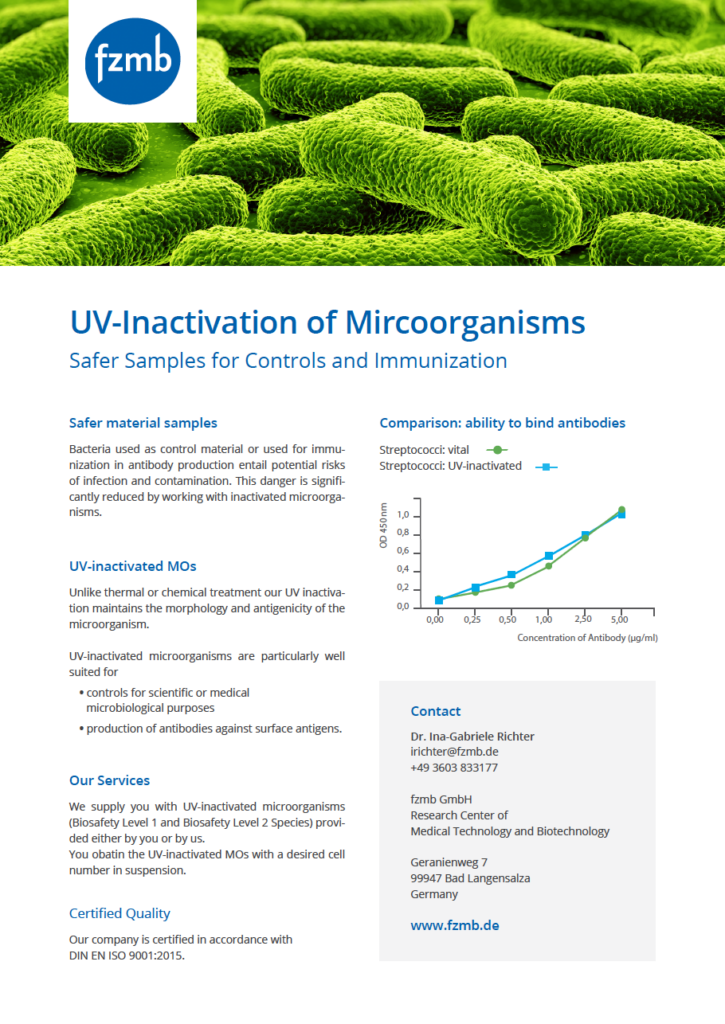
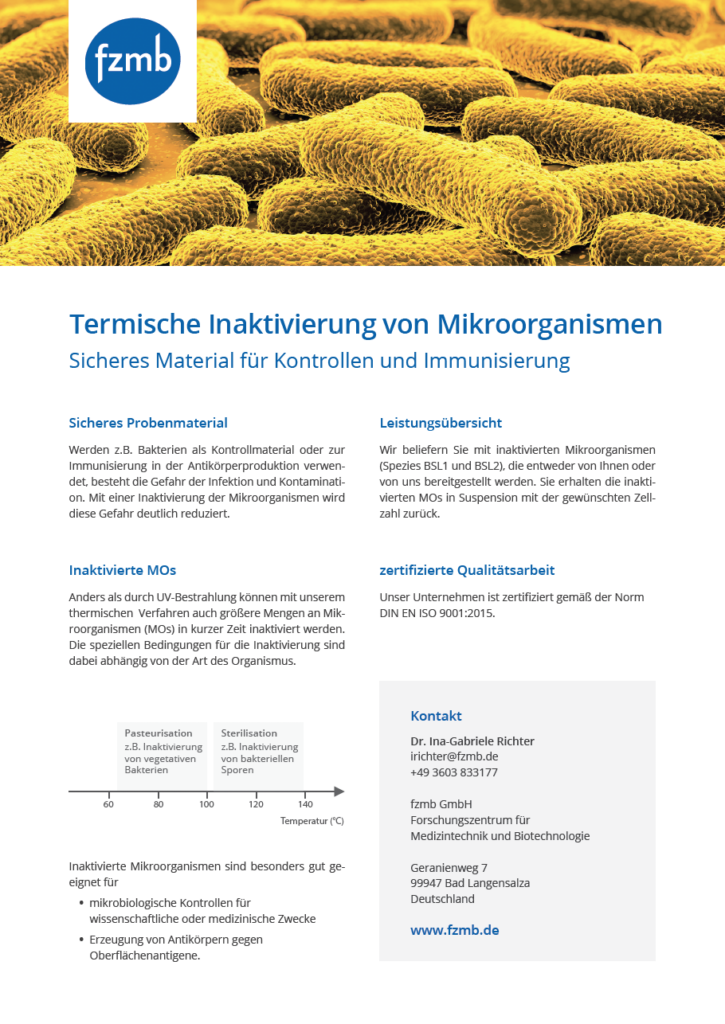
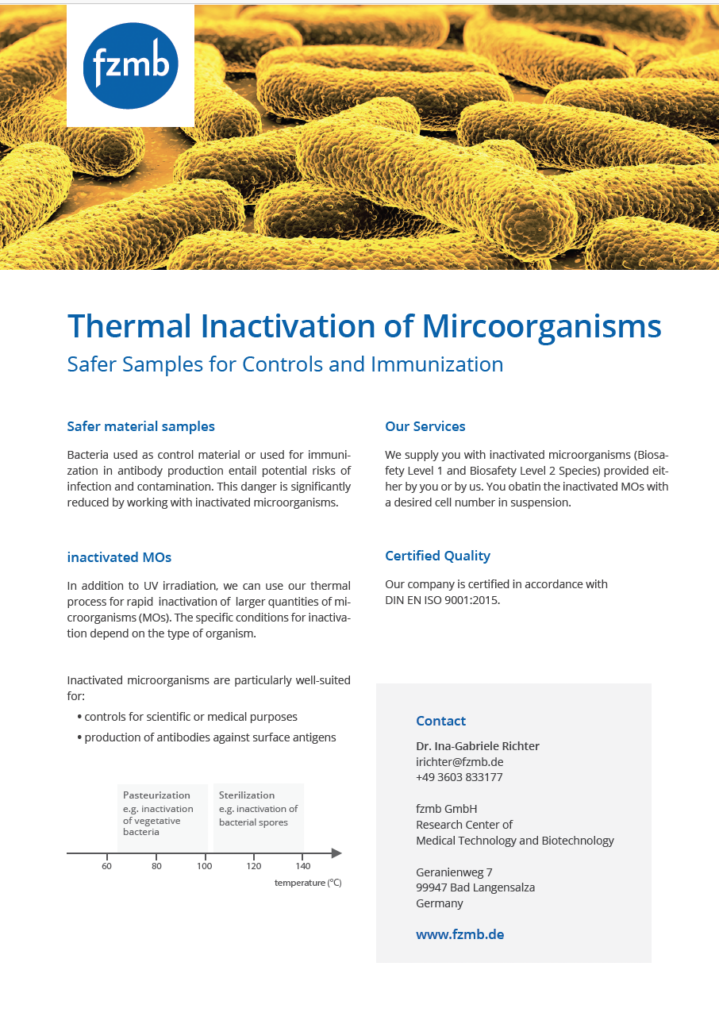
The use of inactivated microorganisms as control material or for immunization for antibody production can minimize the risk of infection and contamination. To do this, the microorganisms in question are inactivated by a special treatment using UV radiation or heat.
UV inactivation of microorganisms
UV-inactivated bacteria and viruses are particularly well suited as microbiological control material for scientific or medical purposes. The high-energy UV light damages the DNA, causing it to be inactivated. However, the macromolecular outer surface remains intact.
We offer UV-inactivated microorganisms as whole cell preparations (e.g. inactivated bacteria such as Legionella or Streptococcus or other species according to BSL1 and BSL2). You receive the UV-inactivated MOs in suspension with a set cell count and determine the desired buffers and additives.

Thermal inactivation of microorganisms
Unlike UV irradiation, our thermal process can also be used to inactivate large quantities of microorganisms in a short period of time. The specific conditions for inactivation depend on the type of organism.
For example, inactivated bacteria are particularly suitable for generating antibodies against surface antigens. If inactivated bacteria are used as reference material to vital bacteria, comparable results are obtained.

Information as PDF (deu/engl)
Contact
Dr. Ina-Gabriele Richter

phone +49 3603 – 833 177
Development and production of immunoassays
Lateral flow assays (rapid tests)
The lateral flow assay as an inexpensive on-site test
The lateral flow assay (LFA) is an immunological strip test. It combines the principle of thin-layer chromatography with antibody-based detection (colorimetric, enzymatic or fluorescence). An LFA is the basis for cost-effective, highly sensitive and reliable detection of a wide range of analytes.
As a point-of-care test (POCT), lateral flow assays find multiple applications e.g. in immunodiagnostics or in the analysis of environmental and food samples.
Reliable detection of various samples with high sensitivity
Imunoassays can detect the analytes of interest down to the nanogram range, in some cases even the picogram range. Qualitative and quantitative detection is possible from a wide variety of biological samples with complex compositions without pretreatment.
We develop fast but highly specific test systems with colorimetric, fluorescence or chemiluminescence-based readout for any parameter.
From feasibility to production
We develop LFAs from feasibility to small series or preparation for production in large and mass series, which we realize with our long-standing partner. These immunoassays can be used to diagnostically detect a wide variety of analytes in complex sample matrices. Highly specific and affine monoclonal and polyclonal antibodies are required for reliable selective binding of the analyte in a liquid phase or tissue sample. Their production and application-related characterization is one of our core competencies.
Performance overview
- Development of lateral flow assays (LFA) for qualitative/quantitative detection of biomarkers.
- Optimization of assay components and steps for the benefit of sensitivity and assay speed
- Validation of the developed LFA
- Production of small batches (> 5,000)
- Preparation for large-scale production
Contact
Enzyme-linked immunosorbent assays (ELISA)
Development of ELISA tests
The ELISA(enzyme-linked immunosorbent assay) is used for the qualitative and/or quantitative detection of an analyte (antigen) in a sample. In addition, many samples can be analyzed in parallel and automated in a laboratory environment.
The ELISA is an antibody-based detection method. This immunoassay is based on an enzymatic color reaction (colorimetric, chemiluminescent, fluorescent), which is read out with an ELISA reader. Detectable analytes are not only proteinogenic components of microorganisms such as bacteria or viruses, but also hormones or toxins, for example.
Production of ELISA tets: from feasibility to in-house production
We develop ELISAs from feasibility to series production. These immunoassays can be used to diagnostically detect a wide variety of analytes in complex sample matrices. Highly specific and affine monoclonal and polyclonal antibodies are required for reliable selective binding of the analyte in a liquid phase or tissue sample. Their production and application-related characterization is also one of our core competencies.
Performance overview
- Development of ELISAs for the qualitative detection of micro- and macromolecules (formats: indirect ELISA, sandwich ELISA).
- Development of ELISAs for qualitative detection of analytes (format: sandwich ELISA).
- Optimization of assay components and steps for the benefit of sensitivity and assay speed
- Validation of the developed ELISA
- Production in small and large series
Contact
Microarrays and multiparameter tests
Development and production of microarrays
Development and production of microarrays
Protein and antibody microarray technology offers enormous potential for a wide range of diagnostic applications. Miniaturized, parallelized immunoassays as well as DNA-based microarrays are ideal for generating maximum diagnostically relevant information with small sample and reagent volumes. A microarray thus saves a lot of time, valuable samples and expensive raw material.
Microarrays consist of a large number of microscopic spots that can be precisely deposited on a solid surface by high-precision dispensers. For example, more than 700 spots can be applied in a single well of a 96-well microtiter plate.
From development to production
Our team offers flexible support for feasibility, validation and production projects for various tests based on microarrays.
In our INTER-ARRAY division, we accompany you through all development phases of microarrays, from the feasibility study to pilot production. After successful development, we are available to you as a contract manufacturing partner with our ISO-certified production capacities.
In addition to completely new development, the transfer of existing tests to the microarray platform is also possible.
Microarray quality control
The focus is on the high quality of the microarray products. For production, the dispensing systems operate in a climate-controlled environment with inline QC software, ensuring quality control of all arrays produced.
Information Development and production of microarrays
Further information on the development and production of microarrays can be found on our website www.inter-array.com.
Contact
Katrin Frankenfeld
phone +49 3603 – 833 141
Development and production of multi-parameter tests
Development and production of multiparameter tests
Typical examples of multiparameter analysis are allergy and food intolerance tests, the diagnosis of autoimmune, metabolic and infectious diseases, and cancer diagnostics. The technology offers excellent prospects for new ways of individualized diagnostics and personalized medicine.
Multi-parameter analysis in different formats
In our INTER-ARRAY division, we carry out new developments of various multi-parameter tests. Standard detection formats such as ELISA, lateral flow strips, and microfluidic assays can be used, as well as custom platforms.
Our team offers flexible support for feasibility, validation and production projects for various tests.
Information on multi-parameter tests
Further information on the development and production of multiparameter tests can be found on our website www.inter-array.com.
Contact
Katrin Frankenfeld
phone +49 3603 – 833 141